Do people read me?

Friday, February 4, 2011

Happenings - Allan June Paik & me?


I looked into the famous Artist Allan Kaprow with his connection to "Happenings" this last week and found some interesting connections I never would have thought I would have with this artist works.

The idea of "Happenings" which as far as I remember something Allan Kaprow started with his work. Happenings are performances of life so to speak, and the artists organizes the event but the outcome is controlled based on all the participants. It seems to be considering life as art but only when lived completely the present moment, sense the artists are also against repeating any of these "happenings" at least with the same interpretation or recorded in any way. So its the art of the present, physically - doing the action or somehow engaging with the happening and intellectually- by dealing with the situation based on instinct instead of having time to analyze the situation.

In my art work I don't exactly do "Happenings", but I like to think about the immediate reaction an individual has to certain environmental changes based on instinct instead of purely societal. For instance, in my photography series i want to capture the physical changes with the models postures based on the environment they are set in. I feel as though it captures an essence of the human spirit, which is very fragile but extremely powerful if noticed with enough light.

It would have been awesome participating in one of the "happenings". A real self discovering moment.


Thursday, January 27, 2011

Joseph Beuys? hmmmm


So Jeseph Beuys was the artist in which I looked at this week. Joseph first interest was medicine but after his involvement in the war switched mindsets and entered into the Dusseldorf Academy of Art to study sculpture. He is well known in the art world of his work somewhat within and similar to the Flux group which were about (to my understanding) bringing art even more into society by incorporating literature, music, visuals, and everyday life actions. The idea was that everyone can do art and life is art. Many of Joseph's performances brought attention to many different elements of everyday life, and how the viewer part of everyday life interacts with it.

After watching a movie about his work and reading a few tid-bits about his work I'm still in a cloud about what I think of his work. I understand the significance he had of the art world but personally he does not resinate with me. What I mean is, if everything is art doesn't that also mean that nothing is art? I think he boarders on this line way to much, so I lean towards not finding much of his performances relevant and therefore I have tended not to appreciate his work as much as some others seem to.

see for yourself and how you respond to it...


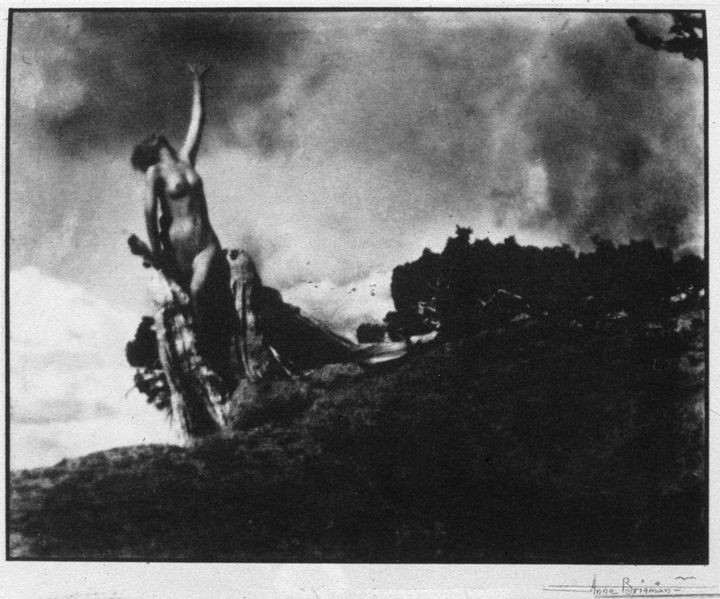
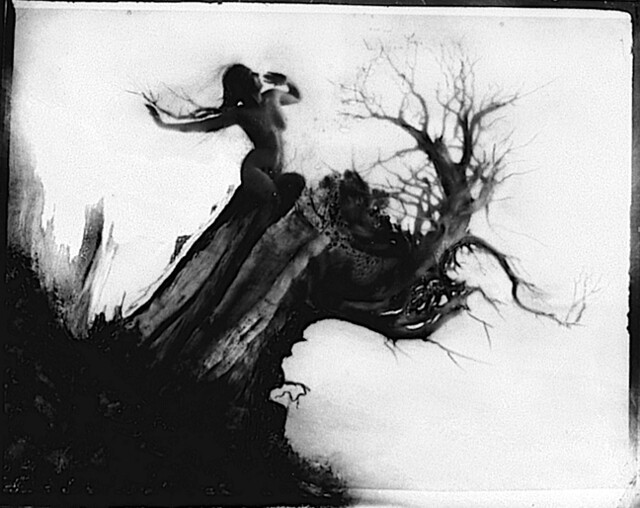
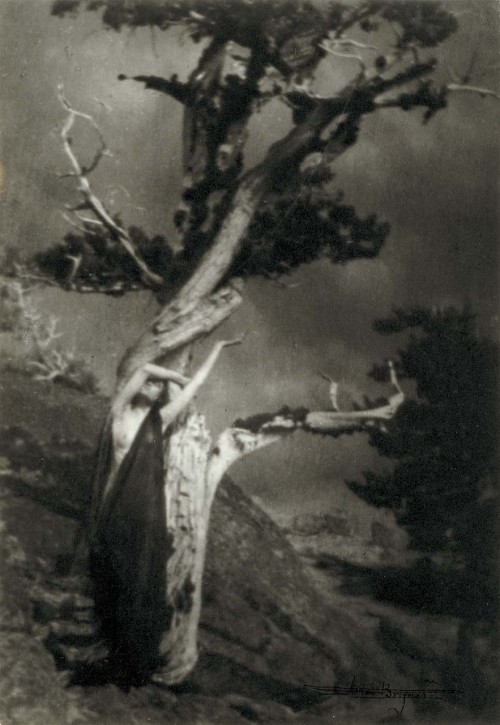
Now, as for my project, I came upon a photographer that I REALLY resonate with; Anne Brigman. She was a pictorialist in the late 1800s and early 1900s. Her work uses the female nude in landscapes, creating compositionally something similar to a renaissance painting. My portraits try to portray the nude model posing with sheer fabric and I realized that my work has very similar lines and framing to her lines created within her landscapes. Her use of curving lines with the body and the environment is something I would like to achieve going into this project.


Thursday, January 20, 2011

Stroszek and me?


In class on wednesday, we watched -without the commentary- the whole film Stroszek by Werner Herzog. We, as a class, had watched this film with Werner doing a commentary the first time about his journey making the film, so watching the film a second time made it a whole different experience in observing the subtly of the narrative and space.

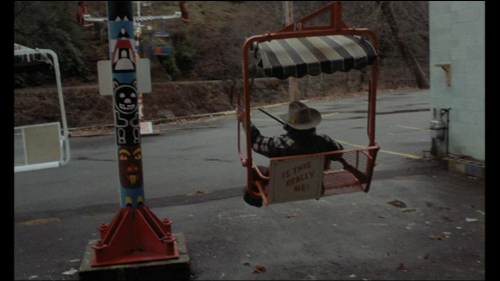
For instance, The part that was most intriguing to me was the very ending of Stroszek. In this scene Bruno came upon an closed down carnival in a rural area of Wisconsin. Bruno puts money in a few machines to watch chickens and a rabbit dance and play the piano, then finds a ski lift and turns it on and starts riding up and down the lift with nothing but his shot gun and a frozen turkey. The very last thing the viewer sees is shots cutting back and forth between one of the machines with a chicken dancing inside and Bruno riding the chair lift until finally you hear an explosion and it cuts to his pick up truck in flames.

This scene is so ambiguous and could have so many different connections to the inner plot line of the narrative- probably why its so interesting to me to begin with.

For instance, does the chicken dancing in the machine symbolize how eva his "sorta girlfriend/ prostitute" is caged within her own obstacles by leaving germany to have a "new life" and still ends up leaving the only family she has to go back into being a prostitute? Is there a strong connection between the frozen turkey as the last thing he holds onto and the dancing chicken? I also found the connection about the question Bruno asked in Germany to Eva about what will happen to his "friends" aka. his musical instruments when he dies, then you see him at a point where he could have killed himself and the viewer sees these caged animals playing similar instruments to what Bruno enjoys to play.


There are so many concepts that could be looked into further I just don't know which one to examine! I think this is one of Herzogs accomplishments with these films, because at a glance they just seem bizarre and about a depressing world some people live in, but taking another look one can see so many connections to the human condition in strange parts of ones life.

How does Strozek relate to my work? I'm not really sure to be honest. I think his goal of "inner landscapes" is intriguing and something I try to achieve in my work as well but I feel (from the very little films I've seen of his) that I take that goal and go 180 degrees from Herzog. I've seen him examine the inner landscapes of the human condition in a place where the character is in turmoil and struggle. When I create art I don't like to focus on that. I like trying to examine the inner landscapes of individuals in a more hopeful sense, showing their light and essence in a positive and joyous manner. I don't believe the dark and grimy parts of the human experience are suppose to be ignored by any means, but I have no motivation to project that message, instead maybe a way out of that? This might sounds extremely cheesy depending on who reads this but I feel life is way to short to not try to reach pure bliss.

As for my project I don't believe I've updated you all on my latest progress. I will be doing a two photography series on two models. In these series they will be posing with sheer fabric. This connection between the body and the sheer fabric I believe creates an visual portrayal of their unique energies. That said, I will also be shooting these models in multiple locations, looking at how though their energies are unique, they are manipulated by their surroundings as well.

Still working on figuring out all the different locations, but if anyone has ideas that seem practical with our lovely wisconsin winters- LET ME KNOW!
Tuesday, January 11, 2011

Importance of Influence- Herzog


In an article I just read titled Herzog on Herzog; Legitimacy, Herzog talks about himself and his influences for his work. I found aspects of what he said quite interesting, and there were a few frazes through his anwers in which instilled a sense of reflection and contimplation for my own work. For instance,

"These are the kinds of landscapes I try to find in my films, the landscapes that exist only in our dreams. For me a true landscape is not just a representation of a deert or a forest. It shows an inner state of mind, literally inner lanscapes, and it is the human soul that is visible through the lanscapes presented in my films..." -Herzog

This part about creating the inner landscapes of our inner state of mind really intrigues me. I know hes particularly talking about how he relates that within his films but I felt it could relate to much more then that. In some ways we're all as artist trying to achieve portraying the inner landscapes of our minds -at least I am at times. For instance, if we were trying to only recreate something that already exist within this world with no alterations, absolutely exactly like is was then are we really doing anything but documentation? I personally don't even think its possible to not "recreate" without part of ones "inner landscape" to shine through, I find this a wonderful thing.

When i'm creating art I feel a lot of times as if I am trying to show some of my "inner landscapes". I take it as through its what makes you live, your perspective on the world which is totally unique to you with its completely unique mixture of the outside nature and nurture within your life. Its showing your human existence and the human condition.

This has also started me thinking about what i'm aware of that influence my work. Some of these influences include people close to me like my family and friends. Sometimes though, i'm influenced by the encounter with a complete stranger who offers nothing but kindness. So I guess I'm influenced by the joy within the human condition, and everything that supports that.

Wednesday, January 5, 2011

Business is art and art is Business.


Andy Warhol (1928-1986), an innovative and influential artist within our modern world. In an section from "The philosophy of Andy Warhol" he brings up the idea that Business is the greatest art. Is that true? Can and or should capitalism be the backbone for art? I think this is a very interesting perspective he takes, and one that any artist or business man for that matter should at least consider and evaluate. For me, I think if you want to be an artist as your career and not just an artist as a hobby then one would need to make a living and develop an income to be able to live within this modern world. Developing an income with your work is really marketing yourself and creating a business. To how much the theory and ins and outs of business become the "highest art" I have yet to discover for myself.

I always had in the back of my mind that business was an important aspect for being any type of artist. If one wants to become an artist as their career then they also need to develop skills that cater to making a profit to be able to live and continue their work, and aware of their own style to know what sorts of people to target when selling their work. What do people want to buy? What is an image or item that someone might not "need" but esthetically or maybe even spiritually they feel like their life would be enhanced by being around in their everyday life. I almost feel as though some artists are unintentional visual psychologists trying to create work that instills something powerful, meaningful, and communicative, that helps the viewers find out things about themselves and their world that they wouldn't of been able to realize without this visual exposure.

At least, I hope to be an artist from that angle, because who wants to create something within the world only for it to absolutely effect no one. NOT ME!

This blog will be an attempt at sharing my own journey in discovering my work within the art world and evaluating the elements of business that contribute to that.

Still developing my project idea that I will be working on for all 9 weeks of class. Though I do want to continue on with people's identity though their energy. That still really fascinates me, and I believe can be presented in lots of different ways to be an effective piece of work.


Friday, June 5, 2009

Final video project.


Okay so my video is about a very specific experience one of my friends had with his religion. - his time spent in a Buddhist monastery in Nepal when he was 15. What i found most interesting was the different identities within what his life was like when he was in the monastery, and the identity when on a small American college campus. How can an very structured and symbolic lifestyle, even for an short period of time alter and shape the rest of your life and what they bring to another environment. The pictures within the video are there to help the viewer understand the drastic change in environment from a Nepal monastery to Appleton WI. 

Also another interesting aspect to look at is how someone with this sort of religion can feel very natural in one environment but not necessarily in another. (like Nepal versus Appleton, WI). I think what you have to take from this instead is how you can take values learned from this experience and apply them to another lifestyle, such as on a college campus. Its almost how if a religion was placed in a new environment, instead of just a single person, and how the values and skills get applied to new experiences and environment- sometimes even altering the religion itself eventually to fit within their new context. 

Monday, June 1, 2009

The Temple in Chicago


The Baha'i Temple in Chicago is one out of only 7 Baha'i Temples in the world. After the discussion in class today about some aspects of the Baha'i religion and then looking at the website for the temple in chicago a few things stood out to me that correlated within both sources of information, and some information from the website was slightly different then i had originally interpreted it from class. Some things that definitely correlated was the continual discussion with system of symbols within any religion. Talking about the symbols importance to the development of a religion in class then reading an active source site helped to clarify and round out my understanding of these symbol's significance. Such as the Nice-pointed Star, The Ringstone, and The Greatest Name. Another thing i found really interesting was the slogan for the home page of the Baha'i sight, "Baha'i Faith, Religion Renewed for a changing World". This concept has a large correlation with the discussion we had in class just today. We discussed how religions are social constructs and are evolved as our societies evolved. How much of the evolving of a religion is consistently evaluated by those within the religion though? Critics are made all the time by outsiders and rebels from the religion but its an interesting concept to completely believe in something yet know its only based on the social environment so if that changes then the beliefs are altered as well. It almost reminds me of Chuang Tzu's values and beliefs with the idea of honoring and excepting change. Not accepting change one is not excepting anything within life because everything is in constant motion and interaction within themselves.